Single-band Bethe lattice
In this example, we study a special one-band Hubbard model, which has semi-circular noninteracting density of states (dos), It corresponds to Bethe lattice with infinite coordination number. You will learn:
- How to set up a simple model calculation
- How the correlation strength induces metal-insulator transition in the Gutzwiller-slave-boson theory
- How to determine the energy gap for the Mott-insulating phase
There is predefined class, which helps generating the energy mesh with uniform weight.
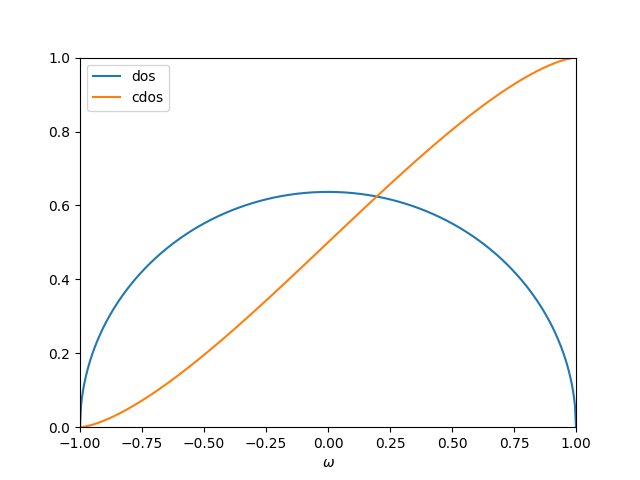
In the model, we use half-band width as the energy unit. The noninteracting dos and cumulative dos is shown as below:
A function to setup the model for CyGutz calculation has been defined,
For convenience, we have also predefined a function to run CyGutz for a list of Hubbard U or chemical potential \(\mu\),
Let us first look at the case of \(\mu\) =0, i.e., in the particle-hole symmetric case. Let us perform a series of CyGutz calculations with increasing U, and check the behavior of the total energy, the double occupancy, and the quasi-particle weight (Z). Recall that in Gutzwiller-slave boson theory, Z=0 implies the system is in the Mott insulating phase, where all the spectral weight becomes non-coherent.
A script for a job of scanning U is defined as
For a hands-on practice, change to a testing directory,
copy the source file or download scan_semicirc.py.
Type the following command:
$ python ./scan_semicirc.py
It will automatically generate the following results:
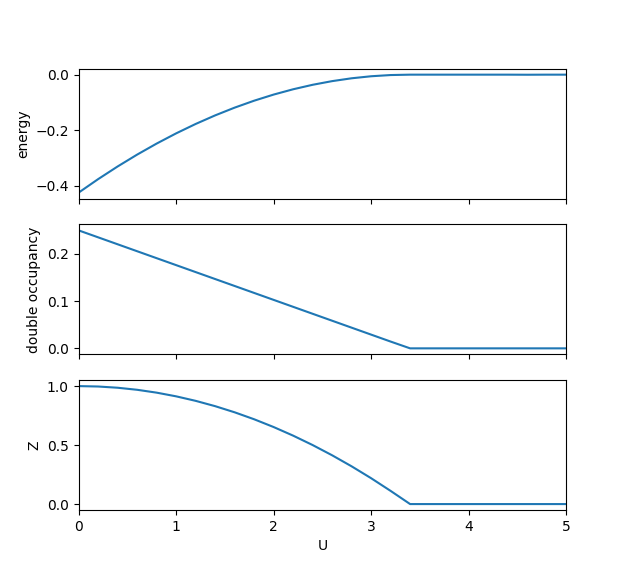
One can see that the \(U_{c}\) ~ 3.4 for the metal-insulator transition.
Although the theory gives a very simplified picture of the Mott insulator, i.e., double occupancy or quasi-particle weight is 0, it is possible to get the band gap size by varying the chemical potential.
A script for a job of scanning \(\mu\) at U=5 is defined as
Type the following command:
$ python ./scan_semicirc.py -mu
It will automatically generate the following results:
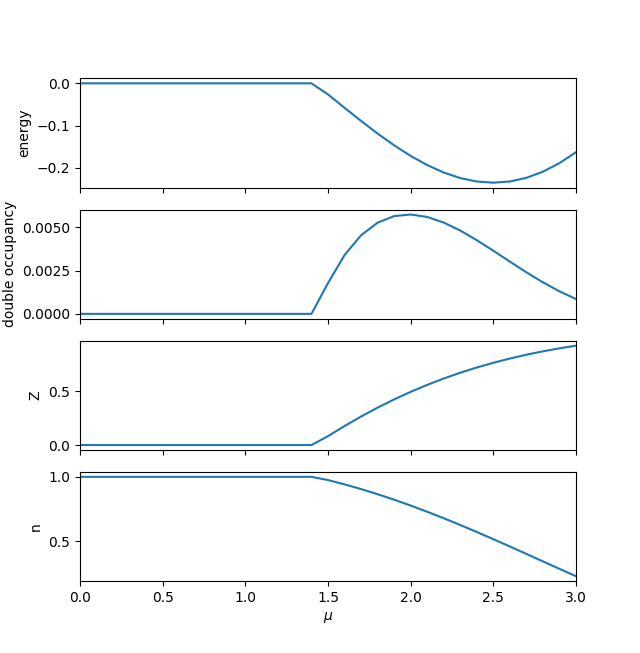
One can see that the physical quantities of interest stay constant in the gap region. When \(\mu\) increases over ~ 1.4, the orbital occupation \(n\) starts to decrease, indicating the gap size ~ 1.4*2 = 2.8. The factor of 2 comes from particle-hole symmetry.